Annual Reports
Vital Farms, Inc.'s annual reports contain management's most considered account of the business. These are the sections, passages and visual pages worth opening in the originals preserved in Sources.
Vital Farms, Inc. — FY2025 Annual Report (Form 10-K) — FY2025 (fiscal year ended December 28, 2025)
The latest 10-K — the pasture-raised 600-family-farm model, a 25% revenue jump to $759M, and a just-remediated revenue material weakness. · Open the full document →
Item 1. Business — Our Company — p. 7 · Read the full section →
The founding story and the distributed family-farm supply chain that is the whole thesis, in management's own framing.
Industry Overview — p. 11 · Read the full section →
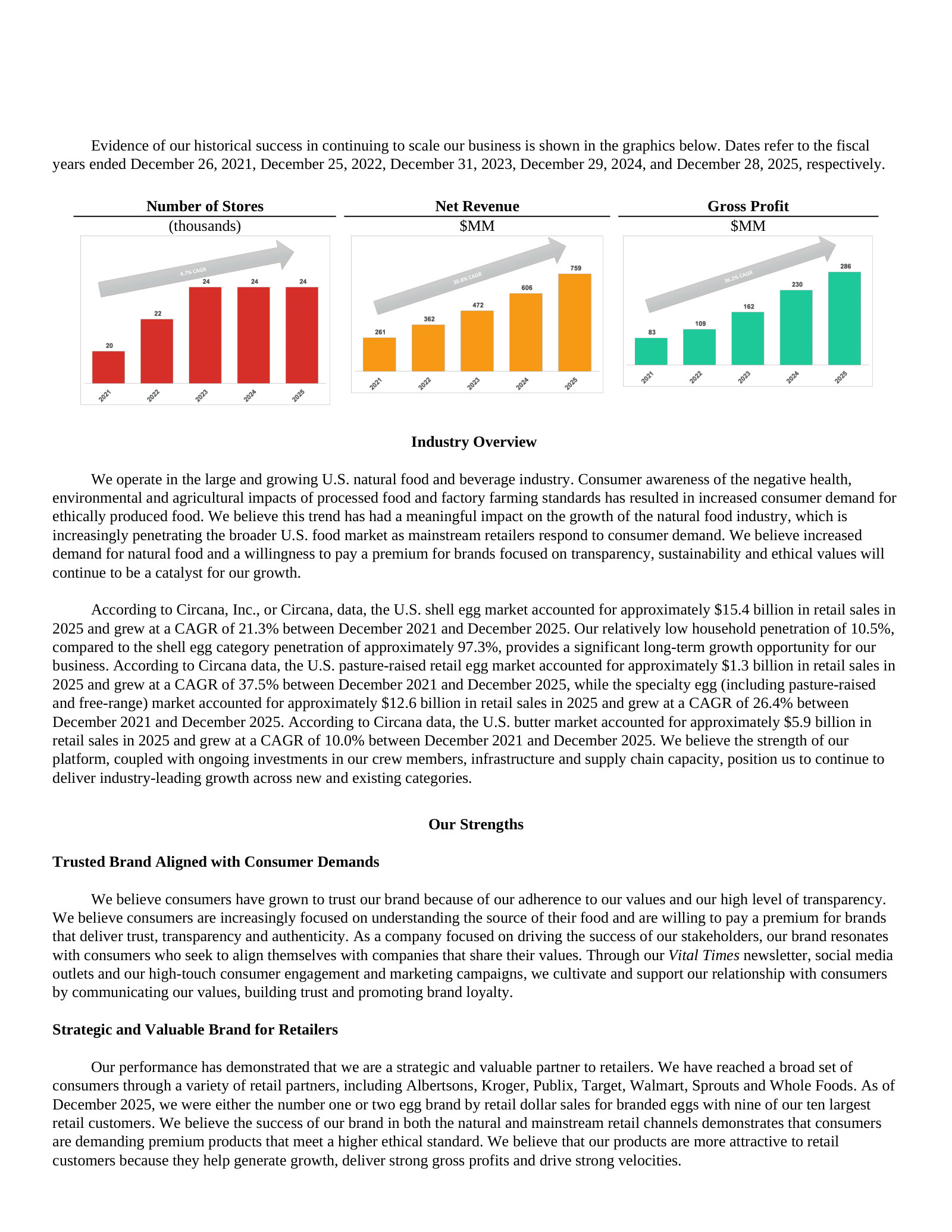
Sizes the runway: 10.5% household penetration against a ~97% category, next to the multi-year store/revenue/gross-profit ramp.
Household penetration of 10.5% versus ~97% for shell eggs overall — the headroom management points to.
Our relatively low household penetration of 10.5%, compared to the shell egg category penetration of approximately 97.3%, provides a significant long-term growth opportunity for our business.
p. 11 · Read in context →
Our Customers — p. 18 · Read the full section →
How the eggs actually reach shelves: 24,000+ stores split across the natural, mainstream and foodservice channels.
Channel mix — natural ~38% and mainstream ~62% of retail dollar sales across 24,000+ stores.
We market our products throughout the United States, with the majority of our net revenue coming from sales of our shell egg products. As of December 2025, we distribute through third parties and direct to retailers to reach more than 24,000 stores. […] Natural channel retailers, including Whole Foods and Sprouts, represented approximately 39%, 40% and 38% of our retail dollar sales in fiscal years 2023, 2024 and 2025, respectively. […] The mainstream channel represented approximately 61%, 60% and 62% of our retail dollar sales in fiscal years 2023, 2024 and 2025, respectively.
p. 18 · Read in context →
Supply Chain — p. 20 · Read the full section →
The physical backbone: a single Egg Central Station facility, the second plant now under construction, and Irish cream for butter.
One processing hub today (Egg Central Station), a second (Vital Crossroads) targeted for 2027, and Ireland-sourced butter cream.
To capitalize on this strong supply network, we own and operate a state-of-the-art shell egg processing facility, Egg Central Station in Springfield, Missouri. […] To support continued supply and further growth, we broke ground in 2025 on Vital Crossroads, our planned second world-class egg washing and packing facility with onsite cold storage in Seymour, Indiana, which we anticipate will be fully operational in 2027. […] The cream for our butter is sourced primarily from dairy farms in Ireland.
p. 20 · Read in context →
Item 1A. Risk Factors — p. 31 · Read the full section →
The two risks most specific to this business: bird-flu/egg-disease outbreaks on its own farms, and ~93% revenue concentration in shell eggs.
Agricultural disease is live, not hypothetical: an HPAI outbreak in 2024 and EDS on 9 then 12 farms in 2024–2025.
Our business activities are subject to a variety of agricultural risks, including pests and diseases such as HPAI and egg drop syndrome, or EDS, the occurrence of which can materially and adversely affect the quality and quantity of products, including shell eggs, that we distribute. […] In fiscal 2024, we experienced an outbreak of HPAI at one of our farms. […] A total of nine of our farms experienced outbreaks of EDS in fiscal 2024 and 12 of our farms experienced outbreaks of EDS in fiscal 2025.
p. 43 · Read in context →
Single-product concentration: shell eggs are ~93% of net revenue.
Shell eggs accounted for approximately 95% of our net revenue in fiscal 2023, 93% of our net revenue in fiscal 2024 and 93% of our net revenue in fiscal 2025. Shell eggs are our flagship product and have been the focal point of our sales and marketing efforts.
p. 35 · Read in context →
Item 7. MD&A — Overview and Results of Operations — p. 98 · Read the full section →
Management's own read on FY2025: what the revenue growth was and how much came from volume versus price/mix.
FY2025 headline: revenue $759.4M, net income $66.3M, Adjusted EBITDA $114.0M.
We have experienced consistent sales growth. We had net revenue of $759.4 million and $606.3 million, net income of $66.3 million and $53.4 million, and Adjusted EBITDA of $114.0 million and $86.7 million in the fiscal years ended December 28, 2025 and December 29, 2024, respectively.
p. 100 · Read in context →
The +25% growth split roughly evenly: $78.3M volume, $74.9M price/mix.
The increase in net revenue of $153.1 million, or 25%, was driven by volume-related increases of $78.3 million and price/mix benefits of $74.9 million. Volume growth was driven by accelerated demand for existing products and expanded item offerings with existing customers.
p. 107 · Read in context →
Item 9A. Controls — Remediation of the Previously Reported Material Weakness — p. 177 · Read the full section →
A prior-year material weakness in the revenue process — and management's statement that it was remediated by year-end 2025.
More annual reports
Vital Farms, Inc. — FY2024 Annual Report (Form 10-K) — FY2024 (fiscal year ended December 29, 2024) · 183 pages · The edition where the revenue-process material weakness was first disclosed, before its FY2025 remediation. · Open →
Vital Farms, Inc. — FY2023 Annual Report (Form 10-K) — FY2023 (fiscal year ended December 31, 2023) · 167 pages · Captures the step-up to $472M revenue and the mainstream-channel expansion earlier in the growth curve. · Open →
Vital Farms, Inc. — FY2022 Annual Report (Form 10-K) — FY2022 (fiscal year ended December 25, 2022) · 139 pages · The Egg Central Station expansion year and the first full year of HPAI as an industry backdrop. · Open →
Vital Farms, Inc. — FY2021 Annual Report (Form 10-K) — FY2021 (fiscal year ended December 26, 2021) · 110 pages · The earliest edition on the shelf ($261M revenue), a useful baseline for the pasture-raised model and B-Corp framing. · Open →